San Germán
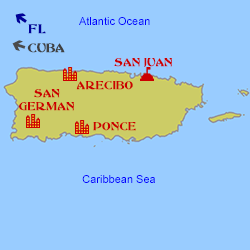
When we first planned our tour of Puerto Rico we aimed to visit just San Juan and Ponce taking the shortest route of less than 120 km (80 miles) between the two cities. We soon decided to slightly extend the outward journey to include El Yunque but it was not until we had booked the trip that we decided to lengthen our return journey to 240 km (150 miles) in order to see the west of the island. When we saw San Germán we were very glad that we changed our plans. This was the second Spanish settlement in Puerto Rico founded in 1511 on the coast. The Spanish divided the island into two administrative areas (Partidos). one centred on San Juan and the other on San Germán. Unfortunately San Germán proved difficult to defend and was pillaged three times by the French, so in 1570 the townsfolk decided to move inland, founding a new settlement called Nueva Villa de Salamanca. In time the settlement became known as San Germán el Nuevo and then just San Germán. Because San Juan was located on the coast and well defended, in the 17th century it increasingly eclipsed San Germán. The decline of San Germán made it what it is today, a sleepy place in the hills with a wealth of historic colonial buildings.
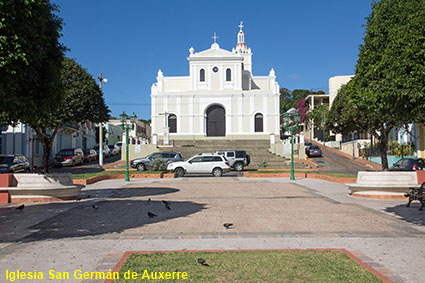
Iglesia San Germán de Auxerre
From its foundation in 1511 San Germán was a parish, but It was not until 1688, over 100 years after it moved inland, that a permanent church was built. Iglesia San Germán de Auxerre needed major reconstruction work between 1717 and 1739 to repair earthquake damage and further reapirs were needed in the 19th century. The tower was seriously damaged by the 1918 San Fermín earthquake and was rebuilt in 1920. The church is renowned for its interior decorations including trompe l'oeil painting on the ceiling that imitates wood coffers. Click Tab 2 to see a view down the aisle or Tab 3 to see the Saints Chapel.
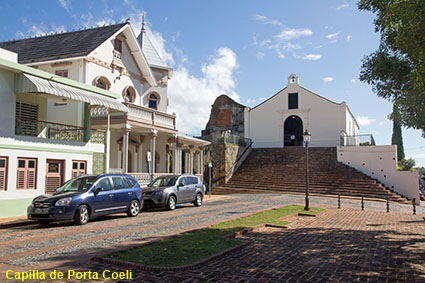
Capilla de Porta Coeli
Dominican Monks built a monastery in the orginal San Germán only to see it destroyed in a French raid. In 1609 a monastery called Convento de Porta Coeli was built in the new San Germán. The monastery fell into disrepair so in the 18th century a new monastery church was built next to it. The ruins in the picture to the left of Capilla de Porta Coeli are all that remain of the original monastery. In 1949 the church was sold to the Government of Puerto Rico. It was renovated in 1960 and turned into the Museo de Arte Religioso displaying religious paintings and wood carvings dating from the 18th and 19th centuries. Click Tab 2 to see a view of the interior of the museum.
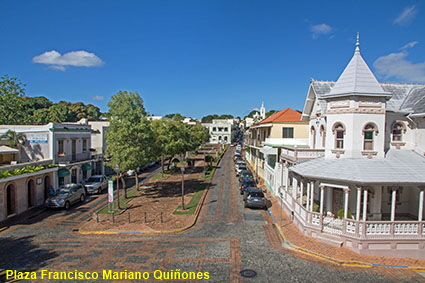
Plaza Francisco Mariano Quiñones
The main plaza is named after Francisco Mariano Quiñones, the son of a wealthy San Germán landowner. Quiñones was a prominent campaigner for the abolition of slavery. When Spain granted Puerto Rico the right of self-determination in 1898 Quiñones was appointed the President of the island’s Cabinet. After the US invasion he campaigned for Puerto Rico to gain statehood. He died in 1908 and is buried in the city.
Click on Minimap to navigate
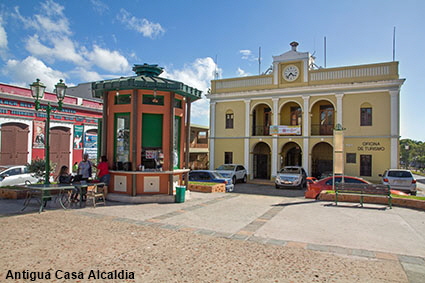
Antigua Casa Alcaldia (Old Town Hall)
It its early years San Germán had a number of Town Halls built of wood. In 1831 the city authorities decided that a more permanent building was required. In 1836 it was decided that the site of the Hospital of the Conception would be the location of the new Town Hall.The building was completed in May 1844 and it remained in use until 1989.




DLU180824



To move forwards or backwards through the Puerto Rico trail click the arrows above, or select your next destination on the Minimap.



© Mike Elsden 1981 - 2025
The contents of this page may not be reproduced in full or in part without permission

