San Juan
The first settlement here called was called Caparra and it was located to the west of modern day San Juan. It was founded in 1508 by Spanish conquistador Juan Ponce de Leon, the first governor of the island. In 1521 the settlement moved to a rocky islet guarding the entrance to San Juan Bay and was named Puerto Rico de San Juan Bautista. Having the same name for the island and its main settlement caused confusion, so in in the 18th century the settlement became known as San Juan. The excellent harbour made it a regular stop for merchant and naval ships travelling between Spain and its colonies. The gold and silver carried by some ships made San Juan a major target for ships from other European countries. Thus in 1533 the Spanish began the construction of major fortifications to protect the town and its harbour. La Fortaleza was built overlooking the harbour and Castillo San Felipe del Morro on the western point overlooking the approach and the entrance. Apart from a brief British invasion in 1598 the fortifications served their purpose until in 1625 a Dutch force attacked from the landward side. They sacked the town but failed to take the castle and were later defeated by a counter-attack. Spain built Castillo San Cristobal and town walls to strengthen the defences. Nowadays the harbour at San Juan is used by cruise ships that disgorge their passengers to view the fortifications and other historic buildings.
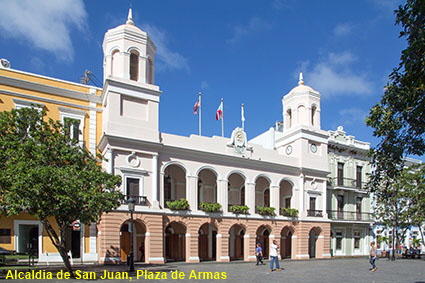
Alcaldia de San Juan, Plaza de Armas
At the centre of the capital cities of most Spanish colonies you will find a Plaza de Armas, and San Juan is no exception. With space in the old town limited by its island location, San Juan has a rather smaller and less grand Plaza de Armas than other capitals, it is a half block rectangle rather than a full square. On one side of the square stands the City Hall, Alcaldia de San Juan. It was built between 1604 and 1789. The arched facade was added in the 1840s, modelled on the facade of Madrid City Hall.
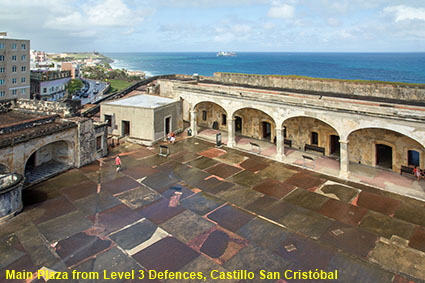
Main Plaza from Level 3 Defences, Castillo San Cristóball
The level of fortification of San Juan can be summed up in one simple statistic, Castillo San Cristóbal and Castillo San Felipe del Morro are less than 1.6 km (1 mile) apart. Even at internet resolution El Morro can be seen in the top right of this picture. San Cristóbal was built to protect San Juan from the landward side following the successful Dutch attack in 1625. By 1634 a small fortification had been built atop Cristóbal Hill but the huge fort that you see now was was not finished until 1790. When completed San Cristóbal was the largest fortification built by the Spanish in the New World. During the 1898 Spanish-American War the guns of Castillo San Cristóbal exchanged fire with the US Navy. After the US invasion, the fort was used by the US Army. The army moved out in 1961 and now the fort is open to the public as part of San Juan National Historic Site. Click Tab 2 to see the Barracks.
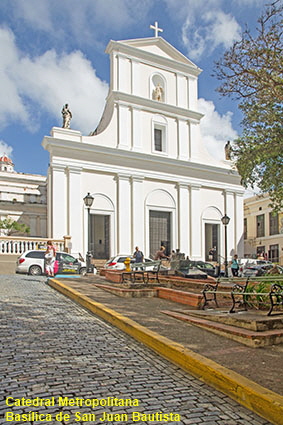
Catedral Metropolitana Basílica de San Juan Bautista
San Juan (or Puerto Rico as it was then called) had a cathedral way back in 1521 but it was built of wood with a thatched roof and and did not survive a hurricane. In 1540 a more solid cathedral was built. It has been modified over the centuries but the original structure was so solid that it is still standing regardless of hurricanes and earthquakes. The cathedral is the final resting place of conquistador Juan Ponce de León, the first governor of Puerto Rico. He was originally buried in nearby Iglesia de San José, but his remains were moved to a white marble tomb in the cathedral in 1908. Click Tab 2 to see a Madonna statue in the cathedral.
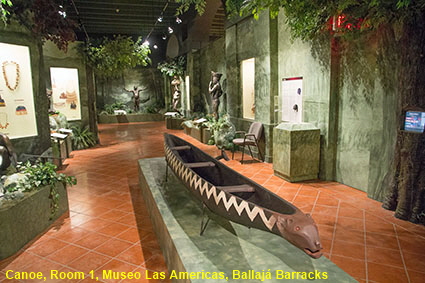
Canoe, Room 1, Museo Las Americas, Ballajá Barracks
Ballajá Barracks were built between 1854 and 1864 to house around 1,000 Spanish troops and their families. The barracks were damaged by bombardment during the 1898 Spanish-American War but were repaired after the war and until 1939 they were used as quarters for the US Infantry. During World War II a military hospital was based in the building. In 1976 the government of Puerto Rico acquired the barracks from the US federal government. The barracks were restored and adapted to be used for cultural and educational purposes. In 1992 the Museo de las Americas opened in the old barracks to exhibit a collection of art and anthropology relating to Puerto Rico and the Americas. Restoration of the old barracks was completed in 1993 and the building now also houses a dance school, the Puerto Rican Academy of Spanish Language and the State Office of Historic Convention.
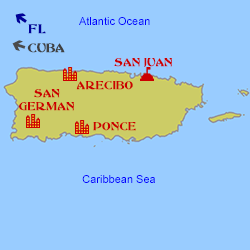
Click on Minimap to navigate


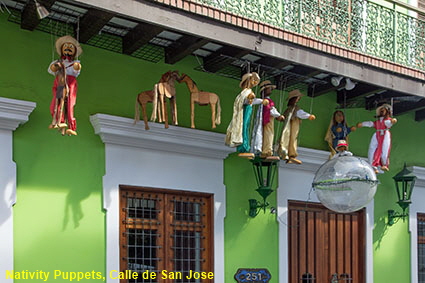
Nativity Puppets, Calle de San Jose
It was late January when we arrived in Puerto Rico but there were still signs of the Christmas celebrations. These Nativity puppets hanging from a balcony added even more colour to the already colourful street scene.
DLU180828



To move forwards or backwards through the Puerto Rico trail click the arrows above, or select your next destination on the Minimap.



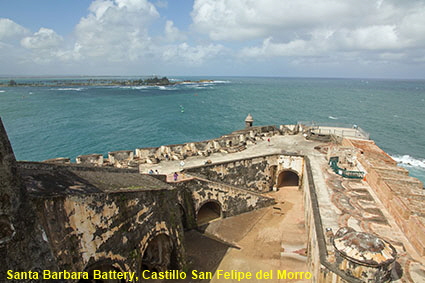
Santa Barbara Battery, Castillo San Felipe del Morro
Castillo San Felipe del Morro (El Morro) sits on a high promontory overlooking the entrance to the San Juan Bay. Construction began in 1539 but the six-level fortification was not fully completed until 1787. During the 19th century a lighthouse was built on the top of the fort to help to guide ships into the harbour. As Spain’s power in the area declined, the armaments at Castillo San Felipe del Morro became outdated. A few modern guns were hurriedly fitted in the run up to the 1898 Spanish-Amercian War, but they made little difference. The fort was attacked three times by the US Navy and the lighthouse destroyed. After the war US forces occupied the fort and the lighthouse was rebuilt by the US Army between 1906 and 1908. In 1915, before the US entered World War I, the fort opened fire on a German supply ship trying to sneak out of the bay to rendezvous with German submarines. The supply ship was forced to return to the bay and its cargo was confiscated. During World War II a large concrete bunker was built on the fort as a command centre for coastal defences, but the fort saw no action. Nowadays Castillo San Felipe del Morro forms part of San Juan National Historic Site. Click Tab 2 for a view of the Main Plaza, or Tab 3 for a view of the Lighthouse built on the Level 6 fortifications.
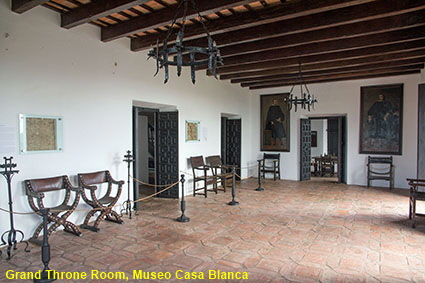
Grand Throne Room, Museo Casa Blanca
Casa Blanca (White House) was built as a fortified residence in 1521. It was intended to be Juan Ponce de León’s residence but he died before he was able to occupy it. The original building was a wooden structure but the current stone structure replaced it after it a disastrous fire. Juan Ponce de León’s descendants lived in the house until the 1773 when they sold it to the Spanish military. After the 1898 US invasion, it became a base for US military commanders. The US Army moved out in 1966 and in 1967 they transferred Casa Blanca to the government of Puerto Rico. In 1971 the Institute of Puerto Rican Culture restored the house as a museum showing how it would have looked in the early years when it was the residence of Juan Ponce de León’s family. Click Tab 2 to see the exterior of Museo Casa Blanca.






© Mike Elsden 1981 - 2025
The contents of this page may not be reproduced in full or in part without permission

