Ponce
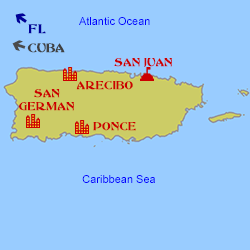
Ponce, on the south coast of the island, is the second largest city by population in Puerto Rico. In the early years of colonization Spanish families began to settle along the banks of the Rio Jacaguas but for improved security they later moved west to the Rio Portugués. The settlement of Nuestra Señora de Guadalupe was founded between 1670 and 1680. In 1692 the chapel at the settlement was granted parish status by King Carlos II of Spain effectively making the settlement a town. It is believed that Loíza Ponce de León, the great grandson of conquistador Loíza Ponce de León, was instrumental in obtaining permission from the king. In the 19th century many merchants from Latin American countries moved to Ponce to escape the economic downturn that followed independence. At the same time Spain was encouraging European settlement of Puerto Rico. As a result Ponce underwent rapid growth and it became a city in 1877. In 1897 it was designated the capital of the southern region of Spanish colonial Puerto Rico, a role that it held only briefly as the USA invaded the island the following year. By the time of the US invasion, Ponce was the largest city in Puerto Rico but it soon went into decline because the US chose to make San Juan the sole administrative centre for the island. In more recent years Ponce has begun to thrive again and in 1992 to became the first autonomous city in Puerto Rico.
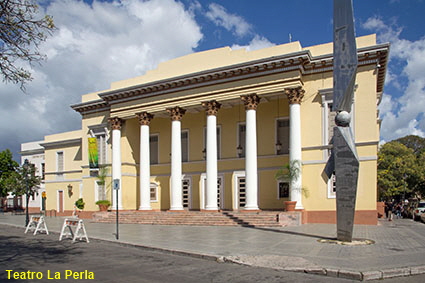
Teatro La Perla
Another building in the the historic district is Teatro La Perla Built in 1864 to a design by Juan Bertoli Calderoni it is the largest theatre in the Spanish-speaking Caribbean and the second oldest in Puerto Rico. It was here in 1901 that the first silent movie was shown on the island. The theatre suffered considerable damage in the 1918 San Fermín earthquake, but was repaired. It has a seating capacity of just over 1,000 and remains in regular use as a venue for concerts, opera and plays.
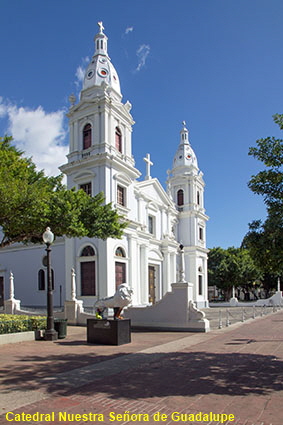
Catedral Nuestra Señora de Guadalupe
On the site of the small chapel that served the original settlement stands a magnificent cathedral. The chapel was demolished in 1835 to make way for a much larger church. The design of the church was unusual because the front facade was built between a pair of octagonal towers instead of the more usual square towers. The church was damaged by several fires and earthquakes, culminating in the 7.1 magnitude San Fermín earthquake in 1918 which destroyed the octagonal towers. The main body of the building remained standing and in 1924 Pope Pius XI made it a cathedral. A new facade, square towers and two chapels were added to the cathedral between 1931 and 1937. The cathedral stands on the main plaza of Ponce. Click Tab 2 to see a picture of the altar
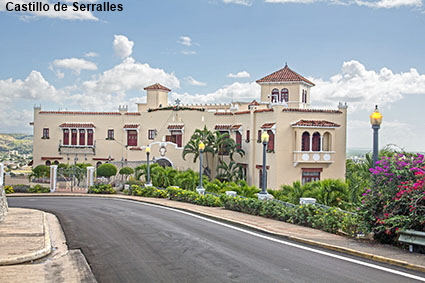
Castillo de Serralles
Sitting on the high ground of El Vigía hill overlooking the city is a castle built in the 1930s. Castillo de Serralles was built for Juan Eugenio Serrallés, the son of rum magnate Juan Serrallés. After Serrallés died the house complete with furniture was purchased at a knockdown price by the City of Ponce. The plan was to turn it into a museum of Puerto Rican Music, but this never happened. Instead it became a house museum with exhibits on the sugar cane and rum industries in Puerto Rico. Museo Castillo de Serralles is open Thursday to Saturday. Unfortunately we were in Ponce on a Monday and Tuesday so we were not able to see inside the museum.
Click on Minimap to navigate


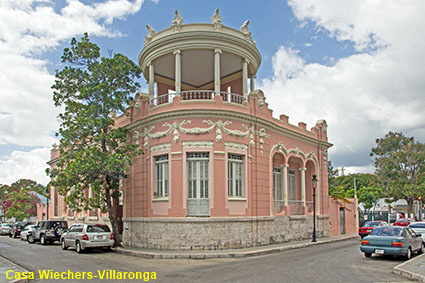
Casa Wiechers-Villaronga
While Castillo de Serralles sits high above Ponce, this mansion is right in the middle of the city’s historic district. Casa Wiechers-Villaronga was built in 1912 by architect Alfredo B. Wiechers as his residence and studio. He designed the mansion in the Neo-classical style as a showcase of his architectural skills. In 1919 under pressure from the US invaders, Wiechers left Puerto Rico for Barcelona. He sold the house to Julio Mercado who gave it as a wedding present to his daughter Elena and her husband Gabriel Villaronga. In the 1990s the Institute of Puerto Rican Culture resored the mansion and opened it as a Museum of Puerto Rican Architecture, It is open Wednesday to Sunday, so like Castillo de Serralles, we were unable to view the interior.
DLU180823



To move forwards or backwards through the Puerto Rico trail click the arrows above, or select your next destination on the Minimap.



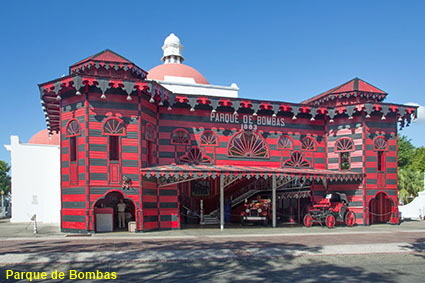
Parque de Bombas
In 1882 an Exhibition & Trade Fair was held in Ponce. The government in Madrid gave Lt. Col. Maximo Meana of the Spanish Army the task of designing a main pavilion for the fair. He designed a pavilion made mainly of wood and finished it in the colours of the city. The result was this striking building. When the fair came to an end, the former pavilion needed a new role. From February 1883 a brigade of firefighters were stationed in the building and in 1885 it became the official firehouse of Ponce, Parque de Bombas. It continued in that role until 1990 when the firefighters moved to a nearby station and Parque de Bombas started a new life as a fire-fighting museum which is open daily. Click Tab 2 to see a picture of Fire Engine No 2 on display in Parque de Bombas


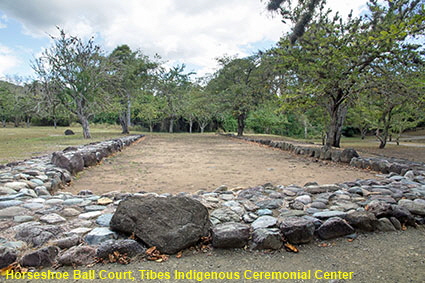
Horseshoe Ball Court, Tibes Indigenous Ceremonial Center
Long before the arrival of the Spanish, the indigenous people of the island had a settlement near Ponce. This site was inhabited by Indians of the Igneri Culture whose ceramics have been dated to the period between 25 AD and 600 AD. From around 1000 AD the site was inhabited by the Taino people. While their huts have long gone, at Tibes they have left behind stone structures consisting of nine ball courts and three ceremonial plazas. After the Spanish arrived the Taino came close to being wiped out by disease. The ceremonial centre at Tibes was abandoned and was lost until 1975 when Hurricane Eloisa brought torrential rain to Puerto Rico. Farmer Don Luis Hernandez was searching or wood to make charcoal when he came across remnants of Tibes uncovered by the heavy rain. The following year he led archaeologists to the site and excavations began. The Tibes Indigenous Ceremonial Center has a museum displaying artefacts found at the site, and a guided tour takes you round a reconstructed Taino village and the remains of the plazas and ball courts. The Horseshoe Ball Court shown here dates back to the Igneri era. Click Tab 2 to see the Ceremonial Plaza or Tab 3 to see the reconstructed Taino village.


© Mike Elsden 1981 - 2025
The contents of this page may not be reproduced in full or in part without permission

