Halifax
The British decided in 1749 that a military outpost was needed on the Atlantic coast to defend Nova Scotia from French attempts to re-take it. The outpost was built on a natural harbour and named after Lord Halifax, then President of Britain's Board of Trade and Plantations. By 1752, the town of Dartmouth had sprung up on the other side of the harbour with a ferry system that still operates today linking it to Halifax. In 1917 French munitions ship Mont-Blanc exploded after a collision causing around 2,000 deaths and destruction of large parts of the city, so much of Halifax is relatively modern. In 1996 Halifax and Dartmouth were united into Halifax Regional Municipality.
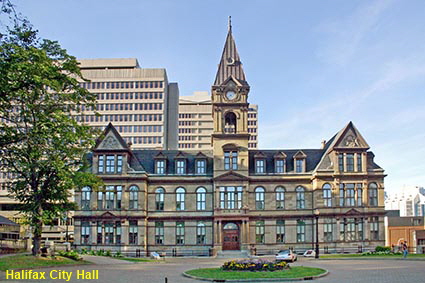
Halifax City Hall
From the mid 1800s the City Authorities were based in the County Court House built in 1810. In 1888 the they got their own imposing building. It overlooks the Grand Parade, which is considered to be the centre of Halifax. In the summer musicians perform on the Grand Parade, but they were packing up when we arrived in the late afternoon.
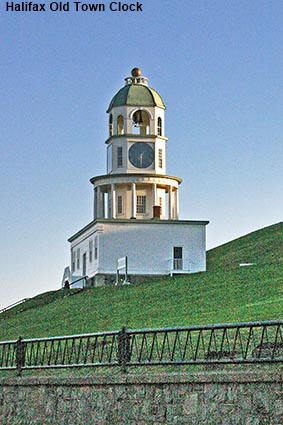
Halifax Old Town Clock
New York has the Statue of Liberty, Paris has the Eiffel Tower, London has Tower Bridge and Halifax has its Old Town Clock. If there is a landmark that defines Halifax it is this one. The clock was a parting gift from Prince Edward, Duke of Kent and father of Queen Victoria who was commander of the British forces here from 1794 to 1800. He arranged for a turret clock to be manufactured for the Halifax garrison before his return to England in 1800. The clock tower was was built on the slopes below the Halifax Citadel. It was completed and keeping time for both the garrison and residents of Halifax by 1803, and the original mechanism is still in use today.
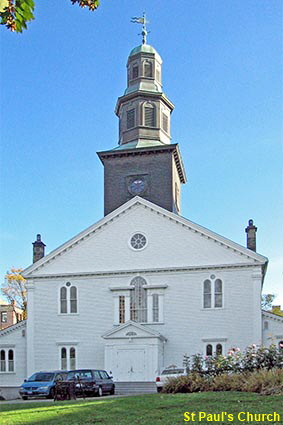
St Paul's Church
While the Halifax Explosion destroyed much of historic Halifax, a few old buildings outside of the Citadel have survived. St Paul’s Church is the only building surviving from the early settlement era. It was built in 1750 using timbers cut in Boston in the then British colony of Massachusetts. The original design was based on St. Peter's Church in Vere Street, London which was designed by James Gibbs, a pupil of Sir Christopher Wren. In the 19th century it was extended and given a new steeple. From 1787 to 1865 it was the cathedral of the Bishop of Nova Scotia. The church was damaged in the Halifax Explosion and a piece of flying debris from the explosion is still lodged in the wall over the doors to the nave.
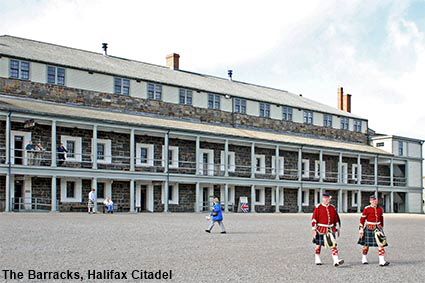
The Barracks, Halifax Citadel
Although the first military outpost was founded in 1749, the current citadel was not completed until 1856 by which time the French threat had long gone. However the War of 1812 had shown that the USA was prepared to attack British territories so the new Fort was considered necessary to defend against a further US attack. British troops were stationed here until 1906 but the no attack took place. The Citadel is now a National Historic Site and the Halifax Citadel Regimental Association recreates history by wearing Highland Regimental dress. Click on Tab 2 for a view of the interior of the barracks.
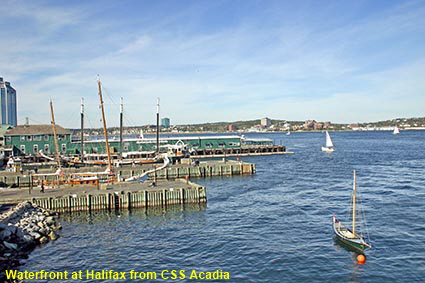
Waterfront at Halifax from CSS Acadia
From the deck of the CSS Acadia you get a good view of Halifax Harbour. It is a natural fjord that provides provides excellent shelter from the stormy Atlantic, which helped Halifax to develop into a major seaport. This picture is looking inland, with the wharves of Halifax on the left and Dartmouth on the right. Beyond Dartford, the fjord widens out again to form the Bedford Basin.
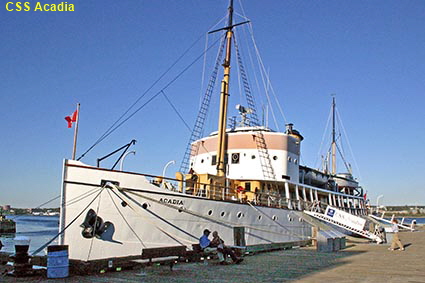
CSS Acadia
The rich maritime history of Halifax is celebrated at the Maritime Museum of the Atlantic. Located on the waterfront, it has a wide range of exhibits including detailed models of many historic ships, artefacts recovered from shipwrecks (including the Titanic) and a display covering the Halifax Explosion in 1917. The CSS Acadia moored outside forms part of the museum. Built in 1913 by Swan, Hunter and Wigham Richardson Ltd. of Newcastle-upon-Tyne, she was designed with an ice-strengthened hull to survey the dangerous northern waters from Hudson's Bay to Nova Scotia. She survived the Halifax Explosion and served as a patrol vessel during World War II.
Home > Oh! Canada > Maritime Provinces > Nova Scotia >
Click on Minimap to navigate






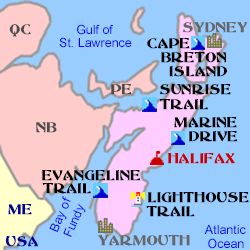
To move forwards or backwards through the Nova Scotia trail click the arrows above, or select your next destination on the Minimap.


DLU060531
© Mike Elsden 1981 - 2025
The contents of this page may not be reproduced in full or in part without permission

